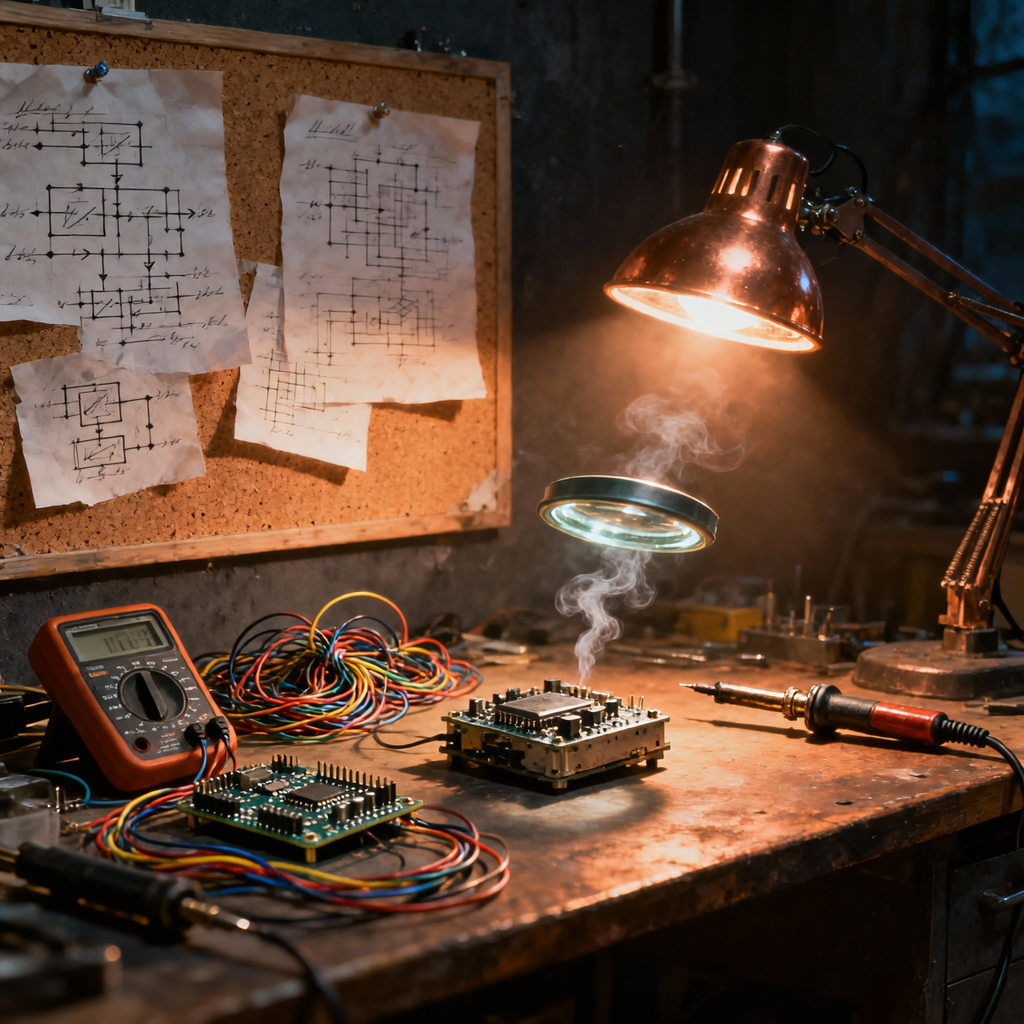
The solo-builder conversation is almost entirely about software — code, agents, apps. And every time, the same assumption slips in: that “one person can now ship” only applies to things that compile.
That assumption is quietly wrong. The same cost collapse that flattened software shipping is happening on the hardware bench, a few years behind and mostly unnoticed. A single maker with a fifteen-dollar microcontroller, AI-assisted design tools, and on-demand fabrication can now assemble, in a weekend, what once required a team of engineers and a factory.
This is the “room” most builders skip — and it’s where the leverage is now widest, precisely because so few people are in it.
What actually changed on the bench
The brain got cheap. A microcontroller with Wi-Fi and Bluetooth — enough to run a real device, talk to a phone, and drive sensors — costs less than a takeout meal. The “compute” that used to require a team to source and integrate is now a component you solder in an afternoon.
The design got assisted. AI tools can now generate and iterate on CAD models, circuit layouts, and enclosures the way coding agents generate software. The expert gate that used to demand years of mechanical or electrical engineering is now a conversational one — you describe the thing, read the output with suspicion, iterate.
The factory got on-demand. You no longer need volume to justify a build. PCB fabrication, CNC, and 3D printing are available as a service, one unit at a time. A prototype that once needed a run of thousands is now a single piece, shipped to your door.
The knowledge got public. The schematics, the firmware, the gotchas — it’s all out there. Hardware, which used to be the most gated hobby, is now one of the most open.
Where the hardware path still hurts (the honest part)
None of this makes hardware easy. It makes it possible, which is different — and there are three costs software builders never feel:
1. The feedback loop is slow. Software iterates in seconds; a bad hardware revision can cost a week of waiting for a new PCB. You can’t out-iterate a slow loop, so you design more carefully up front.
2. The failure is physical and final. A software bug is a log line. A hardware bug is a puff of smoke and a part you have to order again. The cost of “I’ll just try it” is real and sometimes literal.
3. The last 10% is brutal in ways software isn’t. Enclosures, mounting, cable routing, heat, power — the unglamorous physical details that software never has, and that don’t show up in any demo.
Why it’s worth it anyway
For exactly the reasons it’s hard, hardware is the most differentiated thing a solo builder can make.
Software is crowded because the barrier dropped to zero. Hardware is still, relatively, empty — because the barrier dropped from “impossible without a team” to “hard but doable alone,” and most people haven’t recalibrated. The makers who have are shipping physical things that reviewers actually touch, that live on a desk, that a screenshot can’t replace.
A physical device is the strongest possible proof of the core thesis: one person can now ship what took a team. Not just code. A thing you can hold.
Where to start, practically
- Pick a board with a big community (ESP32-class is the sweet spot) — the community is the real manual.
- Buy a starter kit and follow one guided build end-to-end before designing anything yourself. Ship the tutorial’s thing first.
- Design your first board to be forgiving — big pads, through-hole where you can, a schematic you understand line by line.
- Treat fabrication rounds as precious. Because the loop is slow, prototype on a breadboard until the logic is right, then commit to a board.
The hardware room is quieter than the software room. That’s the opportunity. While everyone is arguing about which coding agent to use, a small number of builders are on the bench, assembling things that exist in the physical world — and that’s a category the crowds haven’t flooded yet.
This is the maker room in the decade plan — the same cost collapse as shipping solo in software, playing out one bench at a time.
Sources
- Espressif / ESP32 ecosystem — sub-$20 microcontrollers with Wi-Fi/Bluetooth have made a functional device’s “brain” a commodity component.
- PCB fabrication services (JLCPCB, PCBWay, etc.) — on-demand, low-volume PCB and CNC production removed the volume gate that historically locked solo makers out of hardware.